© Copyright Cupideros, Monday, September 7, 2016
Introduction
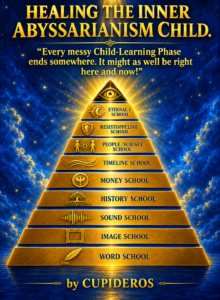
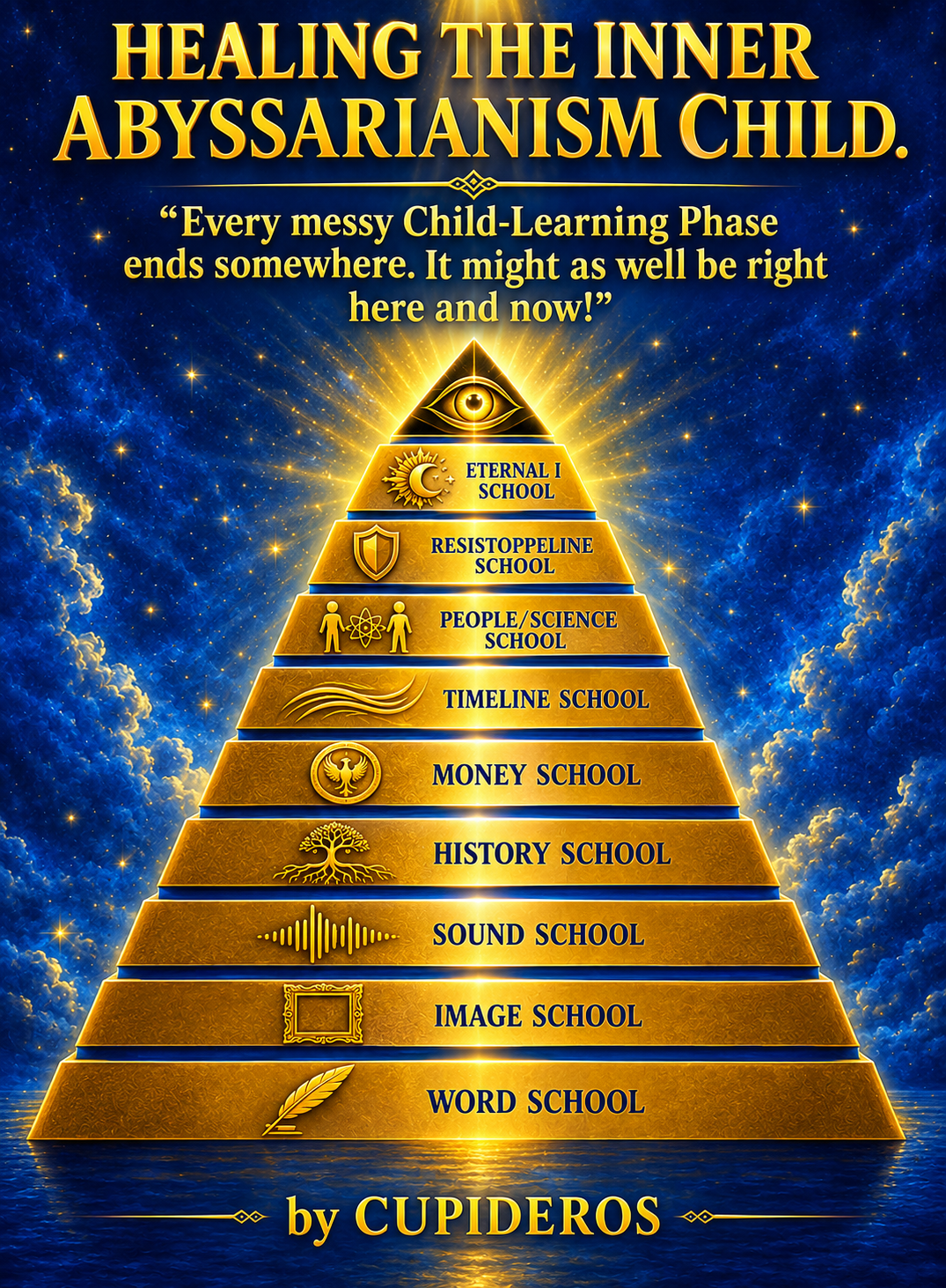
THE ABYSSARIANISM INNER CHILD by Cupideros
“Every messy Child-Learning Phase ends somewhere. It might as well be right here and now!“.
INTRODUCTION
THE CULTURAL SUBTERRANEAN INSIDE YOUR SOUL AND WHY IT MATTERS
“The cultural subterranean memories inside your soul you can’t access are the ones that run your life. And the ones you can access? They’re are either gifts of power, pain points of confusion or Child-Learn Phases you wish you had avoided.”
THE THREE TYPES OF MEMORY
Your brain? It’s not a filing cabinet. It’s more like a sprawling underground library where some books sit on bright shelves you can grab anytime, others hide in dusty boxes you forgot existed, and a few live in a secret vault that only opens when you learn the right knock.
The Abyssarianism Nine Schools call these three types of cultural memory: Easy Recalled Memories (ERMems), Harder to Recall Memories (HRMems), and Super Conscious Memories (SCMems) . Let’s break them down like you’re sorting your bedroom closet.
ERMems are the memories you can pull out without breaking a sweat. Your favorite birthday party. That time you tripped in the cafeteria. What your mom said when you got your first A in math. That first grade drawing your mom posted on the refrigerator after remarking, “The color and light spotlight effects resembled the Caravaggisti inspired Dutch painter Rembrandt’s Aristotle with a Bust of Homer.” These are subconscious—not hidden, just waiting. They sit on the timeline zero to nine years behind you. For most people, their Inner Childhood Memories (ICMems) live right here in ERMems territory.
HRMems are trickier. These are unconscious memories, buried deeper than a gopher in January. They stretch back ten or more years. You can’t just grab them. You need meditation, quiet, or sometimes a sudden smell or song to crack the door open. Ever had a moment where you suddenly remembered something from when you were four, and it hit you like a truck? That’s an HRMem waking up.
SCMems are the big ones. Your soul knows them even if your brain forgot. These are Super Conscious Memories—the kind that feel like they belong to someone else, or maybe to the version of you that exists beyond this lifetime. The more spiritually awake you become, the easier it is to tap into all three types. That’s why Abyssarian Heroes and Heroines meditate twice daily, five minutes or nine minutes at a stretch. Those numbers aren’t random—they’re keys that fit the locks of your timeline.
THE FOUR IMPORTANT ABYSSARIANISM PROCESSES
A couple of other important things, Abyssarian, Hero or Heroine, you’ll heard these phrase a lot:
THINK-IT-THROUGH!
THINK-IT-THROUGH MEANS TAKE THE TIME TO CONSIDER DIFFERENT ASPECTS OF THE PROBLEM. Too many people don’t read the instruction to that DIY furniture set or strawberry cake mix box. They get started right away and fast. Soon they get into the messy middle and wonder how they will fix that furniture so it looks like furniture and not an abstract work of art in a museum; or bake that cake so it looks, smooth and yummy like a strawberry cake in a bakery. THEY DIDN’T THINK-IT-THROUGH! Again, imagine a couple goes on a beach vacation a thousand miles away from home only to notice neither she, nor he, BROUGHT THEIR FAVORITE SWIMSUIT!
So help your Abyssarianism Inner Child heal faster and more completey by taking the time to: THINK-IT-THROUGH!
CHILD-LEARNING PHASE!
What is a Child-Learning Phase? A Child-Learning Phase is an information dump you MUST go through the first time you learn anything. For example, if you want to learn the harp, how do you? Here are some ways it could happen: 1) You watch a video on how to play a harp. 2) You go to a credible harp teacher. 3) You buy a harp and just jump right into trying to play with a mallet hammer, your fingers or guitar pick. The last method #3 demonstrate not THINKING-IT-THROUGH.
If you choose, method #1, you may miss some steps in your THINK-IT-THOUGH PROCESS.
Method #2, the credible harp teacher represents the best way to learn because the harp teacher probably has THOUGHT-IT-THROUGH most completely how to play the harp.
The key to remember is that there is no way for you to learn to play the harp or anything unless someone just dumps information into your head! Think of all the cool and interesting things you learned in schools before the grade you are in now? After you graduate from college or high school, you will still run into CHILD-LEARNING PHASES. If you go into a construction, crab fishing, oil rig drilling, yachting, car mechanic, making a new friend, or engaging in the circus trapeze performing trade—someone will have to give you an CHILD-LEARNING PHASE information dump about that process! This is just a pragmatic, practical fact of life for the 99.9% of us.
A CHILD-LEARNING PHASE does not mean you are broken, or dumb! It means you just don’t know what you just don’t know!
By reading this CHILD-LEARNING PHASE INFORMATION DUMP ON HEALING THE INNER ABYSSARIANISM CHILD, you are learning about healing your Inner Child. This is reflected in the subtitle: “Every messy Child-Learning Phase ends somewhere. It might as well be right here and now!“
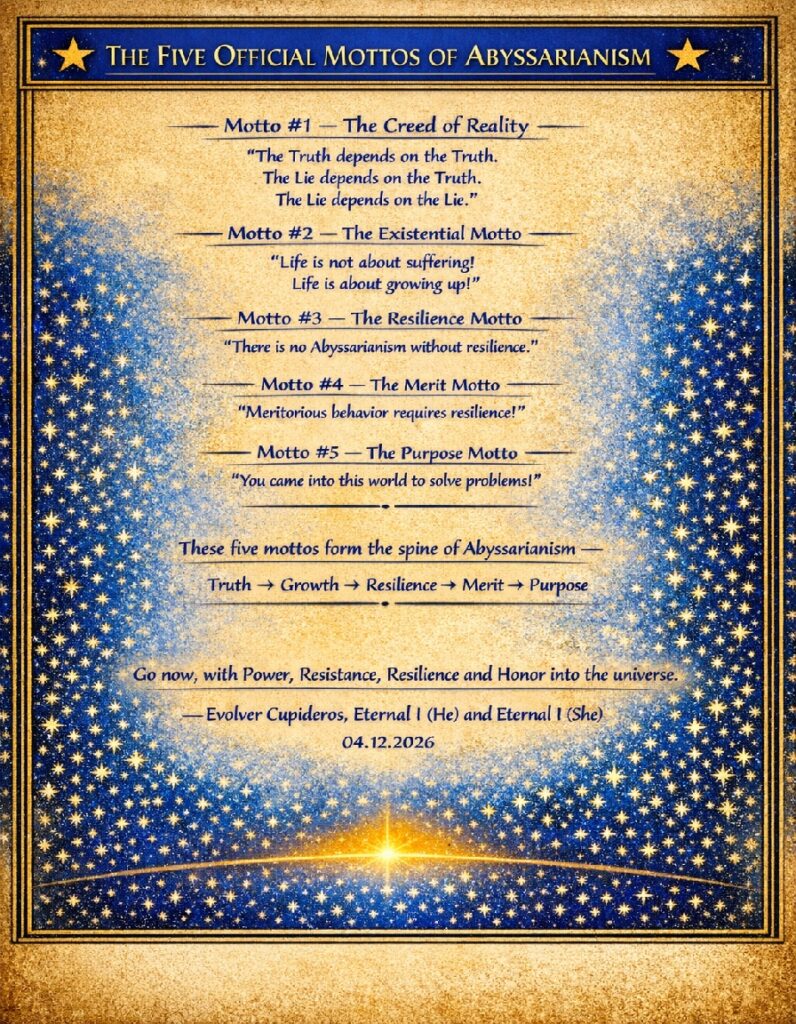
THE ABYSSARIANISM FIVE MOTTO’S PERSPECTIVE:
1. THE TRUTH DEPENDS ON THE TRUTH!
THE LIE DEPENDS ON THE TRUTH!
THE LIES DEPEND ON THE LIES!
2. LIFE IS NOT ABOUT SUFFERING—LIFE IS ABOUT GROWING UP!
3. THERE IS NO ABYSSARIANISM WITHOUT RESILIENCE!
4. MERITORIOUS BEHAVIOR REQUIRES RESILIENCE!
5. YOU CAME INTO THIS WORLD TO SOLVE PROBLEMS!
PATTERN RECOGNITION
Pattern recognition is the general Abyssarianism concept that many patterns in life operate around us all the time! Some patters are done by ourselves and discovered through self-awareness. Other patterns are done by others and discovered through other-awareness. However, some patterns are overlooked by us for self-awareness, other-awareness or Child-Learning Phase reasons. Regardless of why or how we miss out on opportunities or cause our own suffering until we become aware of those patterns. All of life essentially is about recognizing patterns to do that benefit us. While at the same time, recognizing patterns that harm us and avoid them.
The key to understand is as a child, you have to go through Child-Learning Phases over and over. If we knew every pattern before encountering them, we be a wise person indeed! Knowing how to make a million dollars before you even know what money is? Supposed you knew how to hit a baseball home run without every knowing or holding a baseball bat? What a feat to read a book, without knowing how to read alphabets! How can you avoid Child-Learning phases? It’s impossible mostly because that is what “growing up” is all about. Hence, the Abyssarianism’s Fourth Model is “Life is not about suffering; Life is about growing up!”
Not gonna lie (NGL) to you reader: HEALING THE INNER ABYSSARIANISM CHILD promises two things: One, show you good life patterns to do, prosper and heal. And two, show you bad patterns to avoid, minimize losses and heal.
THE ABYSSARIANISM TIMELINE MEMORY YEARS: TIME AND YOUR CULTURAL SUBTERRANEAN MEMORIES
Here’s where it gets personal. The Timeline Memory Years adjust differently depending on how old you are. For anyone eighteen or younger, your ERMems and HRMems start at different points:
Why does age 14 matter so much? In Abyssarianism, fourteen is the age of adulthood. That’s when the innocent veil lifts. You stop seeing the world through a child’s foggy windshield and start seeing reality as it actually is—clear glass, no tint, no filter. The good, the bad, and the everything-in-between.
WHY THIS BOOK EXISTS
So here’s the million-dollar question: Even though we wish people were nice and kind and perfect, the reality is people are messy, what happens when your Abyssarianism Inner Child got wounded by some of those years of messy memory events, first-time Child-Learning Phases? How do you heal that Abyssarianism Child using the Abyssarianism Nine Schools?
That’s what this book is about.
| Age | ICMems Start | HRMems Start |
|---|---|---|
| 5 yo | 2 yo | 5 mo |
| 6 yo | 3 yo | 6 mo |
| 7 yo | 4 yo | 7 mo |
| 8 yo | 4 yo | 8 mo |
| 9 yo | 5 yo | 9 mo |
| 10 yo | 6 yo | 1 yo |
| 11 yo | 7 yo | 1 yo |
| 12 yo | 8 yo | 3 yo |
| 14 yo | 9 yo | 4 yo |
| 15 yo | 10 yo | 5 yo |
| 16 yo | 11 yo | 6 yo |
| 17 yo | 12 yo | 7 yo |
| 18 yo | 13 yo | 8 yo |
| 18+ yo | 14 yo | 8 yo |
Why does age 14 matter so much? In Abyssarianism, fourteen is the age of adulthood. That’s when life’s innocent veil lifts. You stop seeing the world through a child’s foggy windshield and start seeing reality as it actually is—clear glass, no tint, no filter. The good, the bad, and the ugly everything-in-between. This is when you start to understand what happened to you—and that’s when the healing can begin.
If you’re over eighteen, your ICMems start at age fourteen, and your HRMems start at age eight. This means that your most accessible childhood memories are from age nine to fourteen and onward. Your deeper, harder-to-reach memories are from age eight and earlier. This isn’t random—it’s the way your brain organized itself. The younger you were, the more raw and unprocessed the memories are. They’re stored in your body, your mind, your nervous system, your soul. And they’re waiting to be accessed.
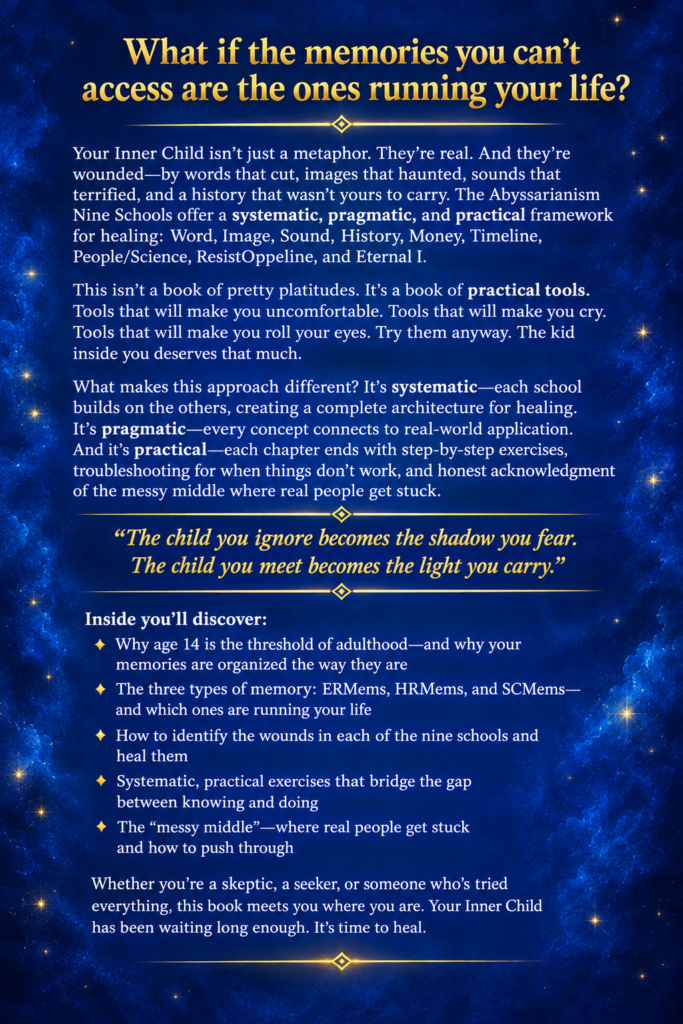
But let me warn you now: this isn’t a book of pretty platitudes. It’s a book of tools. Some of them will feel awkward. Some will make you cry. Some will make you roll your eyes. Run the experiments you want anyway. Try them. The Abyssarianism Hero or Heroine Child inside you deserves that much honor.
The Abyssarianism Nine Schools are not just religious-philosophy. They’re a practical, pragmatic system for healing. Each school addresses a different way that your Abyssarianism Inner Child was wounded—and a different way to heal. The schools are:
- Word School: How words shaped your Inner Child’s sense of self.
- Image School: How images shaped your Inner Child’s sense of safety.
- Sound School: How sounds shaped your Inner Child’s nervous system.
- History School: How family patterns shaped your Inner Child’s identity.
- Money School: How financial anxiety shaped your Inner Child’s sense of security.
- Timeline School: How stuck time points shaped your Inner Child’s relationship.
- People/Science School: How relationships and biology shaped your Inner Child.
- ResistOppeline School: How evil forces shaped your Inner Child’s resistance efforts.
- Eternal I School: How the Divine shaped your Inner Child’s sense of purpose and worth.
Each school is a lens. Each school is a tool. Each school is a door. And together, they form a complete system for healing.
THE HOOK INTEGRATION: WHAT GRABS YOU, WHAT HOLDS YOU, WHAT CHANGES YOU
Every chapter in this book opens with a hook that speaks directly to your pain point. Every exercise closes with a hook that reminds you why you’re doing the work. And every “Messy Middle” checkpoint includes a hook that keeps you from quitting when it gets hard.
Below is the integrated hook timeline for the Introduction—pulled directly from the customer research that shaped this book.
Opening Hook (before the Introduction):
“The memories you can’t access are the ones that run your life. And the ones you can access? They’re are either gifts of power, pain points of confusion or Child-Learn Phases you wish you had avoided.”
Hook Checkpoint #1: After “The Three Types of Memory”
You’ve just read about ERMems, HRMems, and SCMems. Now ask yourself:
“What if the memories you’ve been avoiding are the ones that hold the key to your freedom?”
If you paused, you’re in the right place. The hooks that follow are designed to catch you when your mind tries to slip back into old history of habit patterns.
Hook Checkpoint #2: After “The Timeline Memory Years”
You’ve seen the chart—where your memories start, depending on your age. Now ask yourself:
“What if the memories you can’t access are the ones that shaped you most?”
If that sentence made you uncomfortable, good. Discomfort is the edge of change. Where we are negatively resistant is probably where we should change.
Hook Checkpoint #3: Before “Why This Book Exists”
You’re about to understand why this book was written. Before you start, read this hook out loud:
“You don’t have to heal alone. You don’t have to heal fast. You just have to start.”
Say it again. Your Abyssarianism Inner Child needs to hear it.
Hook Checkpoint #4: During “The Messy Middle”
When you’re reading about where readers get stuck and it feels personal, this hook will catch you:
“The mess is the point. The struggle is the process. You’re not doing it wrong. Think-It-Through!”
Don’t let the messy middle stop you. The hook is permission to keep going.
Hook Checkpoint #5: During “The Abyssarianism Framework”
When you’re learning about the Abyssarianism Nine Schools and if it feels overwhelming, remember:
“You don’t have to master all Abyssarianism nine schools at once. You just have to show up for one.”
This hook stops you from quitting because you overthink it or it feels like too much.
Hook Checkpoint #6: After “The Messy Middle”
You’ve read about where readers get stuck. Now the hook that pulls you out:
“The child you’ve been ignoring is waiting for you. Not for you to be perfect. Just for you to show up.”
Not because it’s easy. Because it’s true.
Hook Checkpoint #7: At the End of “The Science Section”
After reading the research about memory and healing, this hook lands:
“Your brain can change. Your memories can be processed. You can heal.”
It prevents the expectation of a quick fix.
Closing Hook (before the Synopsis):
“The Inner Child you ignore becomes the shadow you fear. The Inner Child you meet becomes the light and gift of power you carry.”
THE MESSY MIDDLE: WHERE READERS GET STUCK WITH THE INTRODUCTION
Now let’s get real. Because the introduction is clean. It’s neat. Life isn’t neat.
Here’s where readers get stuck with the Introduction:
Stuck Point #1: “I don’t believe in any of this.”
You’re skeptical. The concept of Abyssarianism Inner Child, the Abyssarianism Nine Schools, the memory types, Thinking-It-Through, Child-Learning Phases, The Five Abyssarianism Mottos—it all feels like pseudoscience or spirituality that doesn’t apply to you. You’re tempted to put the book down. You feel like it’s not for you.
Stuck Point #2: “I can’t remember my childhood.”
You have a blank spot. You don’t have any memories—or very few. You feel like you’re missing a piece of the puzzle. You wonder if you’re broken because you can’t remember.
Stuck Point #3: “I remember too much.”
You’re the opposite. You remember everything. Every detail. Every wound. You’re overwhelmed by your memories. You wish you could forget. You feel like you’re drowning in the past.
Stuck Point #4: “I’m afraid of what I’ll find.”
You know there’s pain in your past. You’ve been avoiding it for years. You’re afraid that if you open the door, you won’t be able to close it. You’re afraid of what you’ll discover.
Stuck Point #5: “I’ve already done the work.”
You’ve been to therapy. You’ve read other books. You’ve done the work. You feel like you’re already healed. You wonder if this book has anything new to offer.
Stuck Point #6: “I don’t have time for this.”
You’re busy. You have a job, a family, a life. You can’t commit to a long book or a deep practice. You feel like you don’t have the bandwidth.
Stuck Point #7: “I don’t want to be a victim.”
You’re afraid that if you acknowledge your wounds, you’ll become a victim. You’ll be defined by your past. You’ll lose your power. You’d rather stay strong, stoic, and ignore the pain.
Stuck Point #8: “I’ve tried before and it didn’t work.”
You’ve tried other healing modalities. Therapy. Books. Workshops. Nothing worked. You’ve given up hope. Your trust factor is low. You’re skeptical that this book will be any different.
Stuck Point #9: “I don’t believe my childhood was that bad.”
You tell yourself it wasn’t that bad. Other people had it worse. You feel like you’re making a big deal out of nothing. You feel guilty for even wanting to heal.
Stuck Point #10: “I don’t know where to start.”
The book is big. The Abyssarianism Nine Schools are many. You feel overwhelmed. You don’t know how to begin. You feel paralyzed.
COMMON MISTAKES WITH THE ABYSSARIANISM INTRODUCTION
Here’s what most people do wrong—and what you need to avoid:
Mistake #1: Skipping the Introduction. You think you know what the book is about. You want to jump straight to the chapters. But the Introduction is the foundation. Without it, you’ll miss the context. Read the Introduction. It matters. You’ll find it easier to Think-It-Through healing your Abyssarianism Inner Child.
Mistake #2: Reading the Introduction but not engaging. You read the words but don’t do any inner work. You don’t ask yourself the questions. You don’t sit with the concepts. The Introduction is a practice, not just a reading. This is a refusal to go through the Child-Learning Phase on healing your Abyssarianism Inner Child.
Mistake #3: Taking the memory types too literally. You think the memory types are hard categories. They’re not. They’re metaphors. Use them as tools, not as boxes.
Mistake #4: Comparing your memory to others. You see someone else who remembers more (or less) and think you’re failing. Memory is personal. Your timeline is your own. Comparison is the thief of healing. You are the only one negatively judging you—stop it.
Mistake #5: Deciding the book isn’t for you. You make a snap judgment based on the Introduction. You decide it’s too spiritual, too scientific, too something. Give the Child-Learning Phase a chance. The chapters are different from the Introduction.
Mistake #6: Doing the work alone. You think you can heal in isolation. You don’t tell anyone what you’re doing. You don’t seek support. This makes the work harder. Healing is relational—you need others to hold the space for you. If it is too personal hold space with Eternal I (He and She) or buy a Your Thoughts—My Thoughts Abyssarianism Journal by Cupideros from LuLu.com. This way you learn both version what the author Cupideros taught and your opinions on what the author Cupideros taught. No brainwashing here. You are free to think and have your own thoughts about Healing the Abyssarianism Inner Child.
Mistake #7: Expecting immediate results. You think you’ll read the Introduction and be healed. Healing takes time. Be patient with yourself. Your Abyssarianism Inner Child has been waiting a long time. They can wait a little longer.
Mistake #8: Forgetting that the journey is the point. You think healing is a destination. It’s not. It’s a journey. The Introduction is the first step. Don’t rush to the end.
Mistake #9: Giving up when it feels hard. The Introduction might bring up painful memories. You might feel overwhelmed. You might start to overthink it. You want to quit. But the hard part is the healing part. Don’t stop when it gets difficult. Apply one of Abyssarianism Mottos:
2. LIFE IS NOT ABOUT SUFFERING—LIFE IS ABOUT GROWING UP!
3. THERE IS NO ABYSSARIANISM WITHOUT RESILIENCE!
4. MERITORIOUS BEHAVIOR REQUIRES RESILIENCE!
5. YOU CAME INTO THIS WORLD TO SOLVE PROBLEMS!
Once you take that Abyssarianism Motto’s perspective move onward with reading the book, and doing the inner work required to heal.
Mistake #10: Forgetting that your Abyssarianism Inner Child is worth it. You think you’re not worth the effort. You think healing is for other people. But your Abyssarianism Inner Child is worth it. You are worth it. Don’t give up on yourself.
THE ABYSSARIANISM FRAMEWORK: THE NINE SCHOOLS IN BRIEF
Before we dive into the chapters, let me give you a brief overview of the nine schools. Each chapter will go into detail, but this Child-Learning Phase overview will help you understand the framework.
1. The Word School. Words are sneaky little things. They don’t just describe reality—they build it inside your head. The Word School teaches that your Abyssarianism Inner Child was shaped by the words directed at you—negative words that stacked up like stones, creating walls around your self-worth. By identifying negative words, reframing them, and bombarding yourself with positive words, you can give your Abyssarianism Inner Child the language they needed all along to heal and flourish.
2. The Image School. Images don’t just pass through your eyes; they land in your soul. The Image School teaches that your Abyssarianism Inner Child was shaped by what you saw—the angry faces, the slamming doors, the empty chairs. Some people and some propaganda tries to trap you with negative, with ugly images and art. By identifying negative images, re-scripting them with better endings, and creating new positive images, you can give your Abyssarianism Inner Child a new visual landscape.
3. The Sound School. Sounds are physical. They travel through the air and hit your eardrums, triggering your nervous system before your mind can catch up. The Sound School teaches that your Abyssarianism Inner Child was programmed by sounds—the yelling, the crying, the slamming, the silence. By identifying negative sounds, desensitizing yourself to them, and bombarding yourself with positive sounds, you can give your Abyssarianism Inner Child a new soundtrack.
4. The History School. History isn’t just something you read in textbooks. It’s something you inherit. The History School teaches that your Abyssarianism Inner Child carries the weight of generations before you. The traumas, the patterns, the expectations—they’re all inherited. Also, great deal of traumas, patterns and expectations are taught by parents, and other relatives of The Abyssarianism Inner Child!By understanding your cultural subterrains of your family history, recognizing patterns, and reframing the past, you can release the burdens that aren’t yours to carry.
5. The Money School. Money is a strange thing. It’s just paper, just numbers, just symbols. But it carries so much emotional weight. The Money School teaches that your Abyssarianism Inner Child learned about money—and about worth, safety, and self-esteem—long before they understood economics. By inventorying negative money beliefs, reframing them, and practicing abundance, you can give your Abyssarianism Inner Child a healthier relationship with money.
6. The Timeline School. Time is a weird thing. It feels linear—past, present, future—but your Abyssarianism Inner Child doesn’t experience it that way. They experience it as a loop or a train stop—only the train never arrives to take your Abyssarianism Inner Child to its promised destination! The Timeline School teaches that your Abyssarianism Inner Child is stuck at points on the timeline where they were hurt, abandoned, or denied. By realizing your cultural subterrains of your timeline, grieving past hurts, and envisioning a positive future, you can free your Abyssarianism Inner Child from the past.
7. The People/Science School. People are your first mirror. You learn who you are by looking at the faces of the people around you. The People/Science School teaches that your Abyssarianism Inner Child was shaped by relationships—and by the biology of how your brain develops. By inventorying your relationships, grieving the losses, reframing the patterns, and building new connections, you can give your Abyssarianism Inner Child a better experience of people.
8. The ResistOppeline School. Abyssarianism teaches that there is an evil force in the universe—ResistOppeline, the force of resistance training. The ResistOppeline School teaches you to recognize this force and resist it. By identifying where ResistOppeline is active, speaking THE TRUTH THAT DEPENDS ON THE TRUTH, building community, and taking action, you can break HER hold on your life.
9. The Eternal I School.. The Eternal I School teaches that there is a God—or rather, a Divine presence that is both He and She, both masculine and feminine, both creator and nurturer. By identifying your divine wounds, reframing God’s nature, and connecting with a loving Divine presence, you can heal your Abyssarianism Inner Child’s relationship with the Divine making growing up easier to accomplish.
THE SCIENCE BEHIND THE INTRODUCTION
This isn’t just religious-spiritual talk. This isn’t just religious-philosophical talk. The science is real.
Research on memory shows that traumatic memories are stored differently than normal memories. A 2019 study from Harvard Medical School found that traumatic memories are often stored in the amygdala—the fear center—rather than the hippocampus—the memory center. This is why traumatic memories feel present. The brain doesn’t know it’s over. That is the loop, being left at the train station and the train never arriving!
Research on epigenetics shows that trauma can be passed down through DNA. A 2020 study from the University of Zurich found that children of Holocaust survivors had different cortisol responses than children of non-survivors. The trauma was in their genes.
From the Abyssarianism God School or Eternal I (He and She) perspective parents can consciously or unconsciously teach, instruct, even guide the next generation to have the same fears as the older generation held. Single moms can pass on their emotional need for excessive safety to their sons, robbing their sons of the ability to take risk. Risk-taking is a male necessary quality and it must be developed overall in the male’s life as provider and protector of his wife and 4th Government household!
Research on neuroplasticity shows that the brain can change. A 2018 study from the University of Pennsylvania found that participants who engaged in daily mindfulness practice showed measurable changes in brain structure after eight weeks. Your brain is not fixed. It can change.
FROM THE ABYSSARIANISM FIVE MOTTO’S PERSPECTIVE:
1. THE TRUTH DEPENDS ON THE TRUTH!
THE LIE DEPENDS ON THE TRUTH!
THE LIES DEPEND ON THE LIES!
2. LIFE IS NOT ABOUT SUFFERING—LIFE IS ABOUT GROWING UP!
3. THERE IS NO ABYSSARIANISM WITHOUT RESILIENCE!
4. MERITORIOUS BEHAVIOR REQUIRES RESILIENCE!
5. YOU CAME INTO THIS WORLD TO SOLVE PROBLEMS!
So, you see healing your Abyssarianism Hero or Heroine Inner Child is entirely, realistically and pragmatically, religious-philosophically and spiritually possible.
Research on the benefits of integrative healing shows that addressing multiple aspects of trauma—emotional, cognitive, relational, and spiritual—leads to better outcomes. A 2021 study from the National Institutes of Health found that participants who engaged in multi-modal healing practices showed greater reductions in symptoms than those who focused on a single modality. Integration works.
The science is clear: memories can be accessed and processed. Trauma can be healed. The brain can change. You can heal. You can grow up! This book is a tool to help you do it.
WHY THE ABYSSARIANISM NINE SCHOOLS?
You might be wondering: Why nine schools? Why not three? Why not one?
The answer is simple: because wounds are complex. They don’t come in one flavor. They come in many. And healing requires addressing all of them.
Think of it like a house. The Word School is the foundation. The Image School is the walls. The Sound School is the windows. The History School is the history of the house. The Money School is the plumbing. The Timeline School is the electrical system. The People/Science School is the community around the house. The ResistOppeline School is the security system. And the Eternal I School is the soul of the house.
You can’t just fix one part and expect the whole house to be okay. You need to address all of them. That’s what the Abyssarianism nine schools do.
THE NINE ABYSSARIANISM SCHOOL JOURNEY AHEAD
The chapters ahead will take you through each school. Each chapter will explore the negative aspects (how the school wounded your Abyssarianism Inner Child) and the positive aspects (how the school can heal your Abyssarianism Inner Child). Each chapter will include:
- An introduction to the school
- The negative aspect: how the school wounded your Inner Child
- The positive aspect: how the school can heal your Inner Child
- The hook integration: hooks that keep you engaged
- The messy middle: where readers get stuck
- Common mistakes: what to avoid
- Exercises: step-by-step practices
- The science: research that supports the work
- A synopsis: a summary of the chapter
You can read the chapters in order, or you can jump around. Each chapter stands alone. But reading them in order will give you the most comprehensive healing experience.
THE PROMISE OF THIS BOOK
Here’s the promise of this book: You can heal.
Not all at once. Not without struggle. Not without setbacks. But you can heal.
Your Abyssarianism Inner Child isn’t stuck. They’re waiting for you to notice them, to speak to them, to show them that they’re in a logical place, a trustworthy place and a safe place. It won’t happen overnight. It will take time, practice, and patience. But it will happen.
The Abyssarianism nine schools are the tools. Your Abyssarianism Inner Child is the reason. Your healing is the result. And the journey is the point.
You’ve come this far. You’ve read this Child-Learning Phase information dump introduction. You’re on the journey. And that’s the most important thing. That’s everything.
THE FINAL CHALLENGE
Today, right now, do something for your Abyssarianism Inner Child.
Speak a kind word to yourself. Look at a positive image. Listen to a calming sound. Remember your ancestors. Practice gratitude for what you have. Acknowledge where you’re going. Connect with someone. Stand up to ResistOppeline. Receive love from the Divine.
Do one thing that makes your Abyssarianism Inner Child feel loved and honored.
And then tomorrow, do it again.
And the next day, do it again.
And the day after that, do it again.
The practice is the resilient healing. The showing up is the meritorious victory. The journey is the power and resistance to obstacles standing before your destination.
INTRODUCTION SYNOPSIS
The Introduction lays the Child-Learning Phase foundation for the entire book, explaining the three types of memory—Easy Recalled Memories (ERMems), Harder to Recall Memories (HRMems), and Super Conscious Memories (SCMems)—and how they relate to your Inner Child. The three important Abyssarianism processes—THINKING-IT-THROUGH, CHILD-LEARNING PHASE, THE ABYSSARIANISM FIVE MOTTO’S PERSPECTIVE. It introduces the Timeline Memory Years, showing how memories are organized based on your age and why age fourteen is the threshold of adulthood in Abyssarianism. The Introduction also gives a brief overview of the Abyssarianism nine schools: Word, Image, Sound, History, Money, Timeline, People/Science, ResistOppeline, and Eternal I. It explains why the Abyssarianism nine schools are necessary—because wounds are complex and require multiple approaches to heal. The Introduction also includes hooks to keep you engaged, a messy middle section to address where readers get stuck, common mistakes to avoid, and the science behind the framework. The Introduction ends with a promise: you can heal, life is not about suffering; life is learning to growing up, and this book will help you do it. Your Abyssarianism Inner Child is waiting to understand that the world is logical, trustworthy and safe! It’s time to start. Let’s Go!